FILMS FOR HUMAN RIGHTS - latest news from the FFHR network

The average person is acutely unaware of the magnitude of human suffering throughout the globe. As privileged people, it is our responsibility to raise those who are living in anguish.

Film being the most effective way to create awareness, FFHR is dedicated to using documentary films to bring global issues to light. This is accomplished through engaging story telling, within a thought provoking style and a human dynamic.

Please contact FFHR at filmsforhumanrights@gmail.com

Monday, November 27, 2006

Mission


FFHR works with any size Organization, NGO, Non for Profit, Corporation etc. When an important issue that affects Human Rights around the Globe, FFHR will work with your group to document the issue and or story. Thought provoking documentary stories and issues with a human dynamic are the most effective way to create awareness. Whether it be broadcasting the film, selling it, marketing it, or holding public screenings, educating the population of the issue is vital.

The average person is acutely unaware of the magnitude of human suffering throughout the globe. As privileged people, it is our responsibility to raise those who are living in anguish.

Film being the most effective way to create awareness, FFHR is dedicated to using documentary films to bring global issues to light. This is accomplished through engaging story telling, within a thought provoking style and a human dynamic.

Contact us today to see how your organization can partner with FFHR to raise awareness of the issue related to your organization

filmsforhumanrights@gmail.com


Sunday, November 26, 2006

FFHR Film in Haiti

Haiti is the poorest country in the western hemisphere. Its a country that has been plagued by political violence for most of its history. Its estimated annual per capita is a mere $460 (1999). Haiti is stricken with poverty as 85% of Haitians live on less than $1 US per day.

Dependence on foreign aid and years of corruption and dictatorship has made it harder for Haiti's chances of climbing out its sinking economy. It's economy suffered two major blows in the early 1980's. The first was the lost of the Creole pig which took an impact on the peasant economy. It was a response to an outbreak of African swine fever. In assistance with the Haitian Government and USAID, every indigenous pig in Haiti with no compensation for the peasants was killed. USAID admitted later that it perhaps may have been a mistake in eradicating an entire breed of livestock. The second major hit to the Haitian economy was the misleading press connecting Haiti with the spread of HIV/AIDS. Because a number of AIDS cases in southern Florida were linked to Haitian immigrants, the dollar decreased drastically in Haiti. It was later admitted the virus was most likely transported from North America to Haiti. This resulted on a devastating consequence on the international image and tourism of Haiti which to this day has never really recovered.


It's estimated that the Haitians who live in Miami, New York City, Montreal and abroad send more than $300 million a year to help their families who remain in the country. This is equal to the budget of any large aid agency or NGO. Rather the money filtering through government bureaucracy beforehand, the money goes directly to the people.


The human rights situation in Haiti is outrageous. In a slum such as Cite Soleil 200,000 people live in a 5 sq km of land. They live in some of the most brutal and demoralizing conditions imaginable.Some people are so poor they will literally dry mud for a day and eat it the next day. Most of the children in Haiti spend a majority of their time getting water for their families as most have no access to water. 63% of Haiti's population is undernourished and only %25 of the population has access to clean drinking water.

Saturday, November 25, 2006

FFHR document the relationship between Fidel and Chavez


Films For Human Rights was sent out to Venezuela and Cuba to document on Human Rights issues under Fidel Castro's regime, and Hugo Chavez of Venezuela. The two countries have a strong relationship which the United States strongly condemns. The above is a short clip from the documentary.


FFHR Sponsors the Canadian Friends of Burma


Films for Human Rights works with the Canadian Friends of Burma to welcome Refugees from Burma to Ottawa. Canada will welcome over 800 Burmese Refugees in 2006/2007.

Canadian Friends of Burma is a federally incorporated, national non-governmental organization founded in 1991.

CFOB supports the Burma pro-democracy movement in the struggle for peace, democracy, human rights and equality in Burma. Our primary objectives are to raise awareness about the political, human rights and socio-economic situation in Burma and how it pertains to Canadians; to encourage Canadians to take action and to get involved.

CFOB coordinates campaigns and provides assistance to Burma solidarity groups in Canada and abroad, produces educational materials and monitors Canadian relations with Burma. CFOB maintains an on-going dialogue with the Canadian government with regard to federal policy on Burma.

CFOB maintains close links with Burmese exiles in Canada and internationally, including Burma's government in-exile, the student and labour movements, ethnic leaders, journalists, academics and the entire international movement for democracy in Burma. In addition, as much as possible, CFOB acts as a clearinghouse of information about Burma's pro-democracy movement in Canada and works with the Burmese community in Canada.


FOR MORE INFORMATION PLEASE VISIT http://www.cfob.org/
EMAIL: CFOB@CFOB.ORG

Wednesday, September 06, 2006

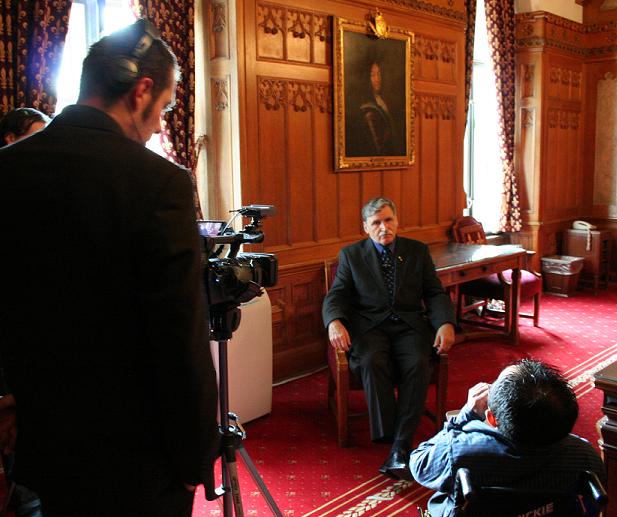
FFHR and Intermode Media talk with General Romeo Dallaire


Films for Human Rights and Intermode Media sat down with Senator Romeo Dallaire to discuss to the horrifying conflict that plagues the African country of Sudan. The interview was part of a documentary on the conflict in Sudan. General Romeo Dallaire entered the senate on March 24th, 2005 where he continues to write and speak out against Human Rights abuses, genocide, and ethnic cleansing. "My interest has been part of the Sudanese action force previously, and now continuing to fight for human rights, for the empowerment of women, and for the ability of nations to live within the respect of international law" Dallaire was quoted as saying in the interview.

General Dallaire consistently struggles to prevent the atrocity in Sudan to become another Rwanda. "They have not literally tried to eliminate from the face of the earth a whole ethnicity. That has not happened yet and the question is will we let that happen?"

Wednesday, August 30, 2006

FFHR Film-makers head to Haiti

On September 10th, 2006, FFHR Film-makers Mitch St.Pierre, and Shawn Kazda begin their tour through Haiti.


-Political Background - Haiti-

In 200 years of independence, Mr Aristide was Haiti's first freely elected president. Months later he was overthrown in a bloody military coup. Not only were Aristide's policies perceived as a threat to US business interests within the region, but often favoured the majority of the impoverished Haitian population from which he drew his support.

Since Aristide's departure, Haiti has been in turmoil as violence between Aristide supporters, rebel factions and government troops has challenged the United Nations peacekeeping force struggling to maintain order in the poorest country in the Western Hemisphere.

-Films For Human Rights / Project Ayiti-

www.ffhr.blogspot.com
FFHR (Films For Human Rights) is dedicated to using documentary films to bring global issues to light. This is accomplished through engaging story telling, within a thought provoking style.

Former Minister of Foreign Affairs, The Honourable Pierre Pettigrew said, "Haiti is a priority for the Canadian government. Canada continues to play a key role in international efforts to stabilize and rebuild the country and uses every forum to reiterate its commitment to long-term involvement in Haiti". Canadians are questionably unaware of the magnitude of the human suffering throughout Haiti. While Haiti is the poorest country in the western Hemisphere, Canada's role is very important in building a stable, democratic and, over time, prosperous society in Haiti. FFHR's film-makers are set out to research, and investigate Canada's progress, and Haiti's Human Rights situation. Through the camera's lens, viewers will join the filmmakers through the untold stories of Haiti.

Tuesday, July 11, 2006

Current Project

CURRENT PROJECT - DARFUR GENOCIDE DOCUMENTARY


Background:

For the past year, documentary filmmaker and Film For Human Rights founder, Mitch St-Pierre has been working in conjunction with Canadian Friends of Sudan to produce a documentary film on the Darfur genocide. Despite the immense and ongoing human suffering, Sudan’s tragedy is still widely ignored by the international community. Meager press coverage of the atrocious events occurring in Darfur and neighboring Chad has also contributed to a lack of concern within the general public. Consequently, many citizens of the world’s most influential nations simply do not appreciate the severity and urgency of the current situation in Sudan. Without the active support of these citizens, members of civil society have been unable to adequately pressure their governments into taking effective and concrete action.


Synopsis:

As part of a mission bringing medical aid to the Sudanese people, Mitch St-Pierre, and filmmaker Shawn Kazda will journey to Sudan to convey the human face of this horrific tragedy. While traveling through the refugee camps and ravaged villages of the countryside, these filmmakers hope to bring the tragic story of the people of Darfur to the television sets and movie screens of Canadian society. Through the camera’s lens, viewers will join the filmmakers as their journey from their home in the heart of Canada to one of the most dangerous, neglected, and oppressed corners in the world.


Sponsored in part by Films For Human Rights, this documentary will be shot on location in Canada, Sudan, Chad, and (if possible) northern Uganda.


This film will also feature interviews with Lt. Gen (ret.) Romeo Dallaire, Justin Laku (Founder of Canadian Friends of Sudan), Hon. Maurice Vellacott (MP Saskatoon-Wanuskewin), former Member of Parliament David Kilgour, and Prof. Eric Reeves.


Project Goals and Objectives:


The goals and objectives of this documentary are as follows:


To air the documentary on national television networks to inspire and motivate Canadian citizens into action.
To motivate viewers to place pressure on the Sudanese Government to continue to provide financial and diplomatic support for humanitarian aid organizations
To pressure the international community to increase physical security in camps for the displaced through constant security patrols with procedures in place to prevent sexual and other violence.
To support the establishment of an international monitoring mechanism for implementation of the Darfur Peace Agreement

Sunday, July 02, 2006

CBC Documentary


A documentary produced by Founders Mitch St.Pierre, and Shawn Kazda will air on CBC this month.

They are now preparing to leave to Sudan for their next documentary.

Their goal is to inspire people to take action through their thought-provoking documentary which will be shot in Africa, and here in Canada.